
table of contents
About the Author: Emmanuel Tankpinou

Introduction: Why Cost-Reducing Procurement KPIs Matter in 2026
In this new year, 2026, procurement performance is calculated not just by negotiated savings, but by how effectively teams protect margins, control spending, and minimize financial risk. Some challenges, like rising cost pressures, supply uncertainties, and tighter budget scrutiny, have elevated procurement from a transactional function to a strategic value driver. Companies that consistently outperform their competitors rely on data-driven Key Performance Indicators (KPIs) to guide decisions, eliminate inefficiencies, and uncover hidden cost leakages.
Nowadays, cost reduction needs a broader lens. Price negotiations alone are no longer sufficient. Leaders must check total cost structures, supplier performance, contract compliance, process efficiency, and working capital impact. In this situation, procurement KPIs become indispensable. The perfect and essential metrics provide visibility into spending patterns, expose operational bottlenecks, and ensure that negotiated benefits translate into measurable financial outcomes.
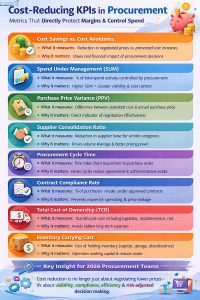
This infographic explains the most important cost-reducing procurement KPIs that modern organizations track to improve profitability and financial discipline. From purchase price variance and spend under management to contract compliance and total cost of ownership, these indicators help procurement leaders move from reactive cost control to proactive value creation.
For procurement directors, CEOs, CFOs, and business decision-makers, understanding these KPIs is essential for building a procurement function that not only reduces costs but also strengthens resilience, supplier accountability, and long-term business performance.
Cost-Reducing KPIs in Procurement
Metrics That Directly Protect Margins & Control Spend
1. Cost Savings vs. Cost Avoidance
What it measures: Reduction in negotiated prices vs. prevented cost increases
Why it matters: Shows real financial impact of procurement decisions
2. Spend Under Management (SUM)
What it measures: Percentage of total spend actively controlled by procurement
Why it matters: Higher SUM = greater visibility and cost control
3. Purchase Price Variance (PPV)
What it measures: Difference between standard cost and actual purchase price
Why it matters: Direct indicator of negotiation effectiveness
4. Supplier Consolidation Ratio
What it measures: Reduction in supplier base for similar categories
Why it matters: Drives volume leverage and better pricing power
5. Procurement Cycle Time
What it measures: Time taken from requisition to purchase order
Why it matters: Faster cycles reduce operational & administrative costs
6. Contract Compliance Rate
What it measures: Percentage of purchases made under approved contracts
Why it matters: Prevents maverick spending and price leakage
7. Total Cost of Ownership (TCO)
What it measures: True lifecycle cost including logistics, maintenance, risk
Why it matters: Avoids hidden long-term expenses
8. Inventory Carrying Cost
What it measures: Cost of holding inventory (capital, storage, obsolescence)
Why it matters: Optimizes working capital and reduces waste
9. Supplier Defect / Quality Cost
What it measures: Cost impact of poor supplier quality
Why it matters: Reduces rework, delays, and unexpected expenses
10. eProcurement Adoption Rate
What it measures: Percentage of transactions handled digitally
Why it matters: Automation lowers processing and transaction costs
Key Insight for 2026 Procurement Teams
Cost reduction is no longer just about negotiating lower prices — it is about
visibility, compliance, efficiency, and risk-adjusted decision making.