
table of contents
About the Author: Emmanuel Tankpinou

Introduction
In the world of manufacturing and global sourcing, supplier performance impacts directly on the cost, quality, delivery, and customer satisfaction. Though some procurement teams track dozens of metrics that look good on dashboards but fail to drive real improvement. The key is not more KPIs but the right KPIs. This infographic explores the supplier performance metrics that really matter and how procurement leaders can use them to create reliable, high-performing supplier partnerships.
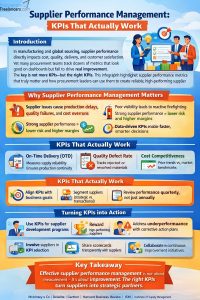
Why Supplier Performance Management Matters
-
Supplier issues cause production delays, quality failures, and cost overruns
-
Poor visibility leads to reactive firefighting
-
Strong supplier performance = lower risk and higher margins
-
Data-driven KPIs enable faster, smarter decisions
Common KPI Mistakes to Avoid
-
Tracking too many metrics
-
Focusing only on price, not value
-
Measuring performance without follow-up actions
-
Using static KPIs that don’t reflect business priorities
KPIs That Actually Work
1. On-Time Delivery (OTD)
-
Measures supply reliability
-
Ensures production continuity
2. Quality Defect Rate
-
Tracks rejected or reworked materials
-
Directly impacts production cost
3. Cost Competitiveness
-
Price trends vs. market benchmarks
-
Supports margin protection
4. Lead Time Consistency
-
Measures variability, not just speed
-
Improves planning accuracy
5. Responsiveness & Communication
-
Speed of issue resolution
-
Critical during disruptions
6. Compliance & ESG Performance
-
Regulatory, ethical, and sustainability adherence
-
Reduces long-term risk
How to Use KPIs Effectively
-
Align KPIs with business goals
-
Segment suppliers (strategic vs. transactional)
-
Review performance quarterly, not just annually
-
Share scorecards transparently with suppliers
Turning KPIs into Action
-
Use KPIs for supplier development programs
-
Reward high-performing suppliers with long-term contracts
-
Address underperformance with corrective action plans
-
Collaborate on continuous improvement initiatives
Quick Wins for Procurement Teams
-
Reduce KPIs to 6–8 critical metrics
-
Automate scorecards using digital tools
-
Involve suppliers in KPI selection
-
Link KPIs to sourcing and renewal decisions
Key Takeaway
Effective supplier performance management is not about measurement—it’s about improvement. The right KPIs turn suppliers into strategic partners.