

table of contents
- 1. Lack of Clear Audit Objectives
- 2. Incomplete or Poor-Quality Data
- 3. Resistance from Internal Teams
- 4. Overlooking Supplier Risks
- 5. Narrow Focus on Cost Only
- 6. Lack of Skilled Auditors
- 7. One-Time Audit Approach
- 8. Ignoring Compliance and Regulatory Changes
- 9. Ineffective Reporting and Insights
- 10. Failure to Implement Audit Recommendations
- Procurement Audit Risks and Solutions Table
- Additional Executive Insight Table
- 1. What are procurement audit services?
- 2. How often should procurement audits be conducted?
- 3. What is the main goal of a procurement audit?
- 4. Should companies use internal or external auditors?
- 5. How do procurement audits reduce costs?
- 6. What tools are used in procurement audits?
- 7. What industries benefit most from procurement audits?
- References / Resources
About the Author: Emmanuel Tankpinou

Key Takeaways
- Procurement audit services are critical for cost control and risk management for a company
- Poor audit execution can lead to inaccurate insights and missed opportunities
- There are some key risk factors, including poor data, lack of expertise, and internal resistance
- Over-focusing on cost is not a good strategy for the company, which can ignore long-term strategic value
- Supplier risk assessment is essential in modern audits
- Do continuous auditing, which is more effective than one-time reviews
- Clear reporting ensures better decision-making
- Implementation of audit recommendations is crucial
- Digital tools enhance audit accuracy and efficiency
- A strategic, data-driven approach maximizes audit ROI
Procurement is an essential activity in the multi-country business, and its audit services are essential for ensuring transparency, cost control, and compliance across sourcing activities. But the fact is that, if you don’t execute properly, procurement audits themselves can introduce risks that undermine their intended value.
Procurement directors and decision-makers of a company need to understand these risks and also need to know how to mitigate them; that is critical to maximizing ROI and strengthening supply chain resilience.
What are Procurement Audit Services?
A company needs procurement audit services; this denotes a structured evaluation of an organization’s procurement processes, supplier contracts, spending patterns, and compliance frameworks. The main aim is to identify inefficiencies, cost leakages, risks, and opportunities for improvement across the sourcing lifecycle. These procurement audits assess if procurement activities align with internal policies, regulatory requirements, and strategic business goals. The procurement director of decision-makers of a company needs procurement audit services, which should be data-driven insights that enhance transparency, strengthen supplier performance, and support better financial and operational outcomes. Ultimately, they transform procurement from a transactional function into a strategic driver of value and risk management.
Why Procurement Audit Services Matter
Procurement audits go beyond compliance checks. They help organizations:
- Identify cost leakages
- Improve supplier performance
- Strengthen governance and controls
- Enhance strategic sourcing decisions
Yet, poorly planned audits can lead to missed insights, internal resistance, and flawed decision-making.
Top 10 Risks in Procurement Audit Services (and How to Solve Them)
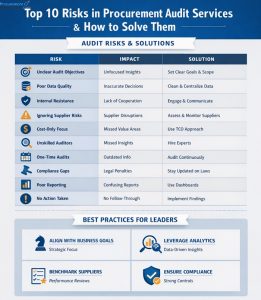
1. Lack of Clear Audit Objectives
Risk:
Audits become generic and fail to deliver actionable insights.
Solution:
Define clear goals—cost reduction, compliance, supplier performance, or risk mitigation. Align audit scope with business priorities.
2. Incomplete or Poor-Quality Data
Risk:
Decisions based on inaccurate or fragmented data can mislead leadership.
Solution:
Invest in data cleansing, centralized procurement systems, and spend analytics tools before initiating audits.
3. Resistance from Internal Teams
Risk:
Employees may see audits as fault-finding exercises, leading to lack of cooperation.
Solution:
Position audits as improvement tools, not policing mechanisms. Communicate benefits clearly across teams.
4. Overlooking Supplier Risks
Risk:
Focusing only on internal processes while ignoring supplier vulnerabilities.
Solution:
Include supplier performance, financial stability, and compliance checks as part of the audit framework.
5. Narrow Focus on Cost Only
Risk:
Ignoring quality, innovation, and long-term value.
Solution:
Adopt a Total Cost of Ownership (TCO) approach, considering lifecycle costs and strategic value.
6. Lack of Skilled Auditors
Risk:
Inexperienced auditors may miss critical insights or misinterpret data.
Solution:
Use experienced procurement professionals or third-party experts with domain knowledge.
7. One-Time Audit Approach
Risk:
Audits become outdated quickly in dynamic markets.
Solution:
Shift to continuous or periodic audit models supported by digital tools and dashboards.
8. Ignoring Compliance and Regulatory Changes
Risk:
Non-compliance can lead to legal and financial penalties.
Solution:
Regularly update audit frameworks in line with global and local regulations.
9. Ineffective Reporting and Insights
Risk:
Audit findings are too complex or unclear for decision-makers.
Solution:
Use dashboards, executive summaries, and actionable recommendations tailored for leadership.
10. Failure to Implement Audit Recommendations
Risk:
Audit insights remain unused, leading to zero business impact.
Solution:
Create accountability frameworks, assign ownership, and track implementation through KPIs.
Best Practices for Effective Procurement Audit Services
To overcome these risks, procurement leaders should:
- Integrate audits into strategic sourcing processes
- Use digital procurement and analytics tools
- Benchmark supplier performance regularly
- Align audits with business and financial goals
- Foster a culture of continuous improvement
Procurement Audit Risks and Solutions Table
| # | Risk in Procurement Audit Services | Impact on Business | Recommended Solution |
|---|---|---|---|
| 1 | Lack of Clear Audit Objectives | Unfocused audits, low-value insights | Define clear goals aligned with business strategy |
| 2 | Poor Data Quality | Incorrect decisions, missed savings | Cleanse data and use centralized systems |
| 3 | Internal Resistance | Limited cooperation, incomplete audits | Communicate value and involve stakeholders early |
| 4 | Ignoring Supplier Risks | Supply chain disruptions, compliance issues | Include supplier evaluation and risk assessment |
| 5 | Cost-Only Focus | Loss of quality and innovation | Use Total Cost of Ownership (TCO) approach |
| 6 | Lack of Skilled Auditors | Inaccurate findings, missed risks | Engage experienced professionals or third-party experts |
| 7 | One-Time Audit Approach | Outdated insights | Implement continuous or periodic audits |
| 8 | Compliance Gaps | Legal and financial penalties | Update audit frameworks regularly |
| 9 | Poor Reporting | Ineffective decision-making | Use dashboards and executive summaries |
| 10 | No Implementation of Findings | No ROI from audits | Assign ownership and track KPIs |
Additional Executive Insight Table
| Area | Best Practice | Outcome |
|---|---|---|
| Strategy | Align audits with business goals | Higher ROI and relevance |
| Technology | Use analytics and digital tools | Better accuracy and speed |
| Supplier Management | Benchmark and monitor suppliers | Improved performance |
| Governance | Establish clear policies and controls | Strong compliance |
| Continuous Improvement | Regular audit cycles | Sustainable value creation |
FAQ Section
1. What are procurement audit services?
Procurement audit services do a great job for the businesses doing sourcing processes, supplier contracts, spending patterns, and compliance to identify risks and inefficiencies.
2. How often should procurement audits be conducted?
The best action to be taken for the organizations’ audits will be annually; this takes continuous monitoring for high-risk categories.
3. What is the main goal of a procurement audit?
The focus of a procurement audit is to improve cost efficiency, ensure compliance, and enhance supplier performance.
4. Should companies use internal or external auditors?
Both are effective for the company. Internal teams understand processes, while external experts bring objectivity and specialized insights.
5. How do procurement audits reduce costs?
This is the main job for the audits: identify overpayments, contract leakages, maverick spending, and inefficiencies in supplier management.
6. What tools are used in procurement audits?
Common tools include spend analytics platforms, ERP systems, supplier management tools, and e-sourcing platforms.
7. What industries benefit most from procurement audits?
Manufacturing, retail, healthcare, and global enterprises benefit significantly due to complex supply chains.
References / Resources
- Deloitte – Procurement Transformation & Audit Insights
- McKinsey & Company – Strategic Sourcing and Procurement Reports
- KPMG – Procurement Risk and Compliance Studies
- PwC – Digital Procurement and Audit Trends
- Institute for Supply Management (ISM) – Procurement Best Practices
- Chartered Institute of Procurement & Supply (CIPS) – Audit Frameworks