

table of contents
- 1. China
- 2. India
- 3. Vietnam
- 4. Mexico
- 5. Bangladesh
- 6. Indonesia
- 7. Thailand
- 8. Poland
- 9. Turkey
- 10. Brazil
- 1. Which country is best for international sourcing in 2026?
- 2. Why are companies moving away from single-country sourcing?
- 3. What industries benefit most from international sourcing?
- 4. What is nearshoring and why is it important?
- 5. How can businesses choose the right sourcing country?
About the Author: Emmanuel Tankpinou

Key Takeaways:
- International sourcing is evolving rapidly in 2026
- China remains the global manufacturing leader
- India and Vietnam are fast-growing alternatives
- Mexico benefits from nearshoring advantages
- Bangladesh dominates apparel sourcing
- Indonesia and Thailand offer strong industrial growth
- Poland and Turkey support European sourcing needs
- Brazil leads in Latin America
- Multi-country sourcing reduces risks
- Technology and AI are reshaping sourcing strategies
- Sustainability is becoming a key decision factor
- Businesses must balance cost, quality, and resilience
Introduction
Nowadays, businesses are evolved with global supply chains; companies are rethinking their international sourcing strategies to balance cost, quality, and risk. Many strategies such as geopolitical shifts, rising labor costs, digital transformation, and supply chain resilience are influencing sourcing decisions in 2026.
Businesses are depending for sourcing on a multi-country approach to diversify risks and ensure continuity. We explore the top 10 countries for international sourcing in 2026, based on cost efficiency, manufacturing capabilities, infrastructure, and global trade potential, in this blog.
Infographic – Top 10 Countries for International Sourcing in 2026
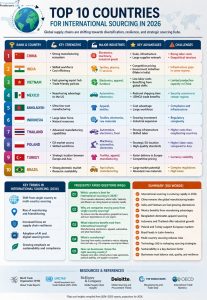
1. China
- Still the global manufacturing leader
- Strong infrastructure and supplier ecosystem
- Ideal for electronics, machinery, and mass production
- Challenges: Rising labor costs, geopolitical tensions
2. India
- Rapidly growing sourcing hub
- Competitive labor costs and skilled workforce
- Strong in textiles, pharmaceuticals, IT services
- Government initiatives boosting manufacturing (Make in India)
3. Vietnam
- Emerging alternative to China
- Low labor costs and trade-friendly policies
- Strong in electronics, apparel, and furniture
- Benefiting from global supply chain shifts
4. Mexico
- Strategic location near the US
- Reduced shipping time and costs (nearshoring advantage)
- Strong in automotive and electronics manufacturing
- USMCA trade benefits
5. Bangladesh
- One of the lowest-cost manufacturing countries
- Global leader in garment and textile exports
- Improving compliance and factory standards
- Ideal for apparel sourcing
6. Indonesia
- Large labor force and growing industrial base
- Strong in natural resources, textiles, and electronics
- Government reforms attracting foreign investment
7. Thailand
- Advanced manufacturing capabilities
- Strong in automotive, electronics, and food processing
- Well-developed infrastructure
8. Poland
- Key sourcing hub in Europe
- Skilled workforce and EU market access
- Strong in machinery, automotive, and electronics
- Ideal for companies targeting European markets
9. Turkey
- Strategic location between Europe and Asia
- Strong textile and apparel industry
- Faster delivery to European markets
- Competitive pricing compared to Western Europe
10. Brazil
- Largest economy in Latin America
- Strong in agriculture, raw materials, and manufacturing
- Growing domestic and export potential
- Challenges: Complex regulations
Key Trends in International Sourcing (2026)
- Shift from single-country to multi-country sourcing
- Rise of nearshoring and friendshoring
- Increased focus on supply chain resilience
- Adoption of AI and digital sourcing tools
- Growing emphasis on sustainability and compliance
Top 10 Countries for International Sourcing in 2026 (Table)
| Rank | Country | Key Strengths | Major Industries | Key Advantages | Challenges |
|---|---|---|---|---|---|
| 1 | China | Strong manufacturing ecosystem | Electronics, machinery, industrial goods | Scale, infrastructure, supplier network | Rising costs, geopolitical risks |
| 2 | India | Skilled workforce, cost efficiency | Textiles, pharma, IT services | Low cost, government support | Infrastructure gaps in some regions |
| 3 | Vietnam | Fast-growing export hub | Electronics, apparel, furniture | Low labor cost, trade agreements | Limited capacity vs China |
| 4 | Mexico | Nearshoring advantage (US market) | Automotive, electronics | Reduced shipping time, USMCA benefits | Security concerns in some regions |
| 5 | Bangladesh | Ultra-low-cost manufacturing | Apparel, textiles | Cost advantage, large workforce | Compliance and infrastructure |
| 6 | Indonesia | Large labor force, natural resources | Textiles, electronics, raw materials | Growing investment, industrial expansion | Regulatory complexity |
| 7 | Thailand | Advanced manufacturing capabilities | Automotive, electronics, food | Strong infrastructure, skilled labor | Higher costs than neighbors |
| 8 | Poland | EU market access, skilled workforce | Machinery, automotive, electronics | Strategic EU location, quality standards | Higher labor costs |
| 9 | Turkey | Strategic geographic location | Textiles, apparel, manufacturing | Fast delivery to Europe, competitive pricing | Currency volatility |
| 10 | Brazil | Strong domestic market and resources | Agriculture, manufacturing | Large market, resource availability | Complex regulations, high taxes |
Key Takeaways
| Factor | Insight |
|---|---|
| Cost Efficiency | Bangladesh, India, Vietnam lead |
| Manufacturing Scale | China dominates |
| Nearshoring Advantage | Mexico is ideal for US companies |
| EU Market Access | Poland and Turkey are strong choices |
| Emerging Opportunities | Indonesia, Vietnam, and India are rising |
| Risk Diversification | Multi-country sourcing is essential in 2026
|
Frequently Asked Questions (FAQs)
1. Which country is best for international sourcing in 2026?
There is no single “best” country. China remains dominant, but countries like India, Vietnam, and Mexico are rapidly gaining popularity depending on industry and location needs.
2. Why are companies moving away from single-country sourcing?
To reduce risks such as supply disruptions, geopolitical issues, and over-dependence on one region.
3. What industries benefit most from international sourcing?
Industries such as:
- Manufacturing
- Electronics
- Apparel
- Automotive
- Pharmaceuticals
benefit significantly due to cost and scalability advantages.
4. What is nearshoring and why is it important?
Nearshoring means sourcing from nearby countries to reduce shipping time and risks. For example, US companies sourcing from Mexico.
5. How can businesses choose the right sourcing country?
Consider:
- Cost and labor availability
- Infrastructure
- Trade agreements
- Political stability
- Supplier ecosystem
Resources & References
- World Trade Organization (WTO) – Global Trade Reports
- UNCTAD – World Investment and Trade Outlook 2025–2026
- McKinsey & Company – Global Supply Chain Insights
- Deloitte – Global Sourcing and Procurement Trends
- World Bank – Manufacturing and Trade Data
- OECD – International Trade Statistics