
table of contents
- Multi-Country Sourcing Is the New Standard
- AI-Driven Supplier Discovery
- Risk-First Procurement Strategy
- Nearshoring & Friend-Shoring on the Rise
- ESG-Compliant Sourcing Becomes Non-Negotiable
- Blockchain-Enabled Supply Chain Transparency
- Total Cost of Ownership (TCO) Replaces Lowest Price
- Digital Supplier Risk Monitoring
- On-Demand & Freelance Sourcing Experts
- Procurement Moves to the Boardroom
- Key Takeaway
About the Author: Emmanuel Tankpinou

Introduction:
Global sourcing is a cost-saving function, yes, but not only that, it has become a strategic pillar of business resilience and growth. We are going into 2026, and sourcing and procurement consultants are navigating a dramatically transformed sourcing landscape shaped by geopolitical uncertainty, rapid digitalization, ESG accountability, and rising supply chain risks.
This infographic, “Top 10 Global Sourcing Trends Procurement Leaders Must Watch in 2026,” explores the most crucial shifts redefining how companies or agents source products, services, and suppliers globally. From AI-driven supplier discovery and multi-country sourcing models to ESG-compliant procurement and real-time risk monitoring, these trends, some new and some old, reflect the new priorities of modern procurement teams.
Designed specifically for company decision-makers, procurement managers, and CEOs, this visual guide offers a quick yet insightful overview of where global sourcing is headed and how forward-thinking organizations can stay competitive, resilient, and future-ready.
We hope you can use this infographic to benchmark your current sourcing strategy, spark internal discussions, and prepare your procurement function for the challenges and opportunities of 2026 and beyond.
Infographic: Top 10 Global Sourcing Trends Procurement Leaders Must Watch in 2026
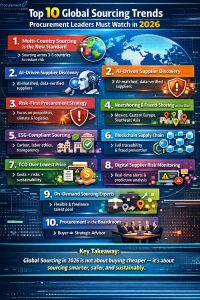
Multi-Country Sourcing Is the New Standard
Why it matters: Single-country dependency = high risk
2026 Reality: Companies source across 3–5 countries to ensure continuity
AI-Driven Supplier Discovery
From: Manual vendor searches
To: AI-matched, data-verified suppliers
Impact: Faster onboarding, better supplier fit
Risk-First Procurement Strategy
Shift: Cost savings → Risk mitigation
Focus Areas: Geopolitics, climate impact, logistics disruption
Nearshoring & Friend-Shoring on the Rise
Why: Shorter lead times + political stability
Hot Regions: Mexico, Eastern Europe, Southeast Asia
ESG-Compliant Sourcing Becomes Non-Negotiable
Drivers: Regulations, investors, brand reputation
Key Metrics: Carbon footprint, labor ethics, supplier transparency
Blockchain-Enabled Supply Chain Transparency
Use Case: Traceability from raw material to delivery
Benefit: Fraud prevention & compliance assurance
Total Cost of Ownership (TCO) Replaces Lowest Price
Includes:
• Logistics costs
• Risk exposure
• Compliance costs
• Sustainability impact
Digital Supplier Risk Monitoring
2026 Capability:
• Real-time risk alerts
• Predictive disruption analysis
• Automated compliance tracking
On-Demand & Freelance Sourcing Experts
Trend: Flexible sourcing teams
Advantage: Local expertise without long-term overheads
Procurement Moves to the Boardroom
Role Change:
Buyer → Strategic Advisor
Focus: Resilience, profitability & long-term growth
Key Takeaway
Global Sourcing in 2026 is not about buying cheaper — it’s about sourcing smarter, safer, and sustainably.
Resources & References
- McKinsey & Company – Global Procurement & Supply Chain Reports
Insights on AI-driven sourcing, resilience, multi-country sourcing, and risk management. - Gartner – Future of Procurement & Supply Chain Predictions
Research on digital procurement, supplier risk monitoring, and procurement’s role at the board level. - Deloitte – Global CPO Survey & Procurement Transformation Reports
Trends in ESG compliance, total cost of ownership (TCO), and strategic procurement. - World Economic Forum (WEF) – Global Trade & Supply Chain Resilience Studies
Analysis of geopolitics, nearshoring, friend-shoring, and global sourcing risks. - KPMG – Procurement & ESG Strategy Insights
Guidance on ESG-compliant sourcing, sustainability metrics, and regulatory readiness. - IBM & Accenture – AI in Procurement & Supply Chain Reports
Use cases for AI-powered supplier discovery, predictive analytics, and automation. - UN Global Compact & OECD Guidelines
Standards for ethical sourcing, labor practices, and supply chain transparency. - Statista – Global Sourcing & Supply Chain Market Data
Market trends, adoption rates, and regional sourcing insights. - Harvard Business Review (HBR) – Procurement & Operations Management Articles
Thought leadership on procurement strategy, resilience, and leadership evolution.