
table of contents
- Step 1: Identify Business Requirements
- Step 2: Market Research & Spend Analysis
- Step 3: Supplier Shortlisting & Pre-Qualification
- Step 4: RFQ / RFP / RFI Issuance
- Step 5: Supplier Evaluation & Comparison
- Step 6: Negotiation & Contract Finalization
- Step 7: Purchase Order & Execution
- Step 8: Quality Control & Compliance
- Step 9: Delivery, Invoicing & Payment
- Step 10: Supplier Performance Review
- Key Benefits of Following These 10 Steps
About the Author: Emmanuel Tankpinou

Introduction
In today’s volatile and competitive business environment, procurement is no longer just about buying goods or services at the lowest price. It requires a structured, transparent, and strategic approach to processes for a successful procurement that balances cost efficiency, quality, compliance, and long-term supplier value.
This infographic, “The 10 Essential Steps of a Successful Procurement Process,” visually explains the entire procurement lifecycle, from identifying business requirements to reviewing supplier performance. The points in it highlight how organizations can make smarter sourcing decisions, reduce operational risks, and build stronger supplier relationships.
This is essential for procurement managers, business leaders, or sourcing and procurement professionals; this step-by-step visual guide will help you understand how well-planned procurement directly contributes to cost savings, operational efficiency, and sustainable business growth.
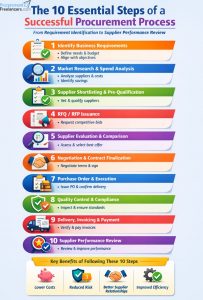
Step 1: Identify Business Requirements
What’s needed & why?
-
Define product/service specifications
-
Set quantity, budget & timeline
-
Align with business objectives
Outcome: Clear procurement scope
Step 2: Market Research & Spend Analysis
Understand the supply market
-
Analyze supplier landscape
-
Review historical spend
-
Identify cost-saving opportunities
Outcome: Informed sourcing strategy
Step 3: Supplier Shortlisting & Pre-Qualification
Find the right suppliers
-
Assess capability & capacity
-
Verify compliance & certifications
-
Check financial stability
Outcome: Qualified supplier list
Step 4: RFQ / RFP / RFI Issuance
Invite competitive bids
-
Share requirements clearly
-
Set evaluation criteria
-
Ensure transparency
Outcome: Comparable supplier proposals
Step 5: Supplier Evaluation & Comparison
Choose the best value
-
Compare price, quality & delivery
-
Evaluate risk & reliability
-
Score suppliers objectively
Outcome: Best-fit supplier selected
Step 6: Negotiation & Contract Finalization
Secure optimal terms
-
Negotiate pricing & payment terms
-
Define SLAs & KPIs
-
Finalize legal & compliance clauses
Outcome: Cost-effective, risk-free contract
Step 7: Purchase Order & Execution
Convert contract into action
-
Issue purchase order (PO)
-
Confirm delivery schedules
-
Ensure internal approvals
Outcome: Procurement execution initiated
Step 8: Quality Control & Compliance
Ensure standards are met
-
Inspect quality & specifications
-
Verify regulatory compliance
-
Manage deviations early
Outcome: Quality-assured procurement
Step 9: Delivery, Invoicing & Payment
Close the transaction smoothly
-
Confirm on-time delivery
-
Match invoice with PO & GRN
-
Process timely payments
Outcome: Supplier trust & continuity
Step 10: Supplier Performance Review
Measure & improve
-
Track KPIs (cost, quality, delivery)
-
Conduct supplier scorecards
-
Identify improvement opportunities
Outcome: Long-term supplier value
Key Benefits of Following These 10 Steps
✔ Lower procurement costs
✔ Reduced supply risk
✔ Better supplier relationships
✔ Improved efficiency & compliance
References & Resources
-
CIPS (Chartered Institute of Procurement & Supply)
Procurement lifecycle models, best practices, and supplier management frameworks. -
ISO 20400 – Sustainable Procurement Guidance
International standards for ethical, transparent, and sustainable procurement processes. -
World Bank Procurement Regulations & Guidelines
Global best practices for transparent sourcing, supplier evaluation, and contract management. -
Deloitte – Global Procurement & Supply Chain Insights
Research on strategic sourcing, digital procurement, and supplier performance management. -
McKinsey & Company – Procurement Transformation Reports
Insights into value-driven procurement, cost optimization, and risk mitigation strategies. -
Harvard Business Review (HBR)
Articles on supplier relationship management, negotiation strategies, and procurement leadership. -
Gartner – Procurement & Supply Chain Research
Frameworks for modern procurement operations, analytics, and technology adoption. -
SAP & Oracle Procurement Whitepapers
Practical guidance on purchase order management, invoicing, compliance, and automation.
#This infographic is based on globally accepted procurement frameworks and real-world sourcing practices followed by leading organizations across industries.