table of contents
About the Author: Emmanuel Tankpinou

Introduction:
Nowadays the market is very competitive, and procurement is no longer just a back-office function; rather, it is a strategic driver of profitability and operational performance. And many organizations are struggling to quantify the real impact of their sourcing activities. In this scenario, the procurement funnel becomes invaluable.
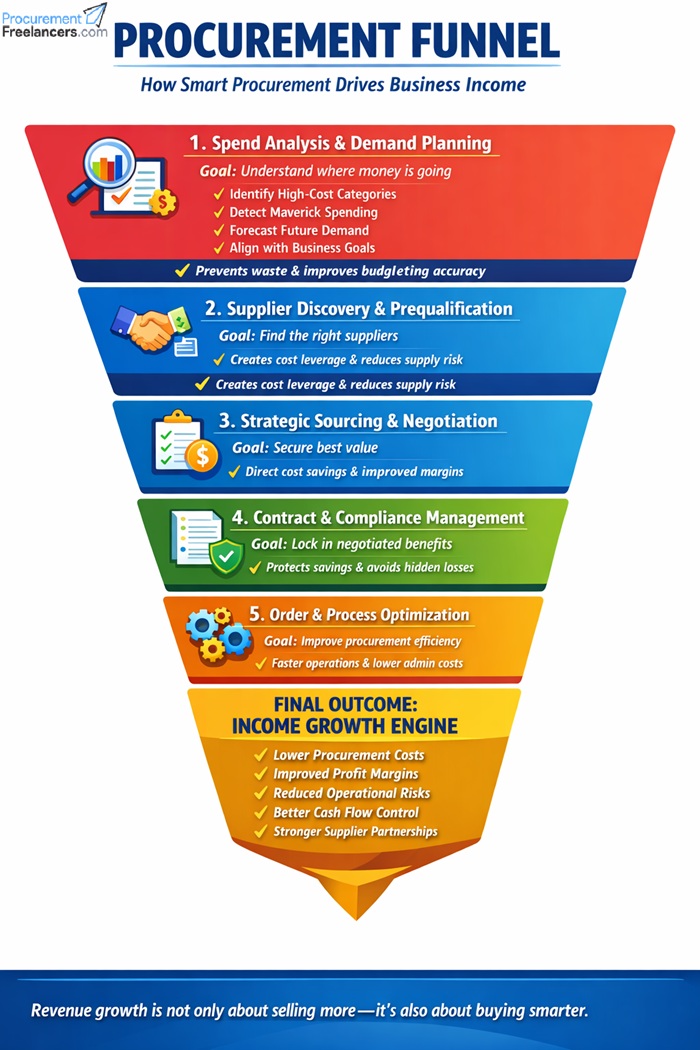
This infographic breaks down the complex journey from total spend to actual income-boosting savings, helping procurement leaders to focus their efforts on the stages that matter most to financial success. The company is optimizing supplier relationships, enhancing negotiation effects, or reducing administrative costs; also, understanding this funnel enhances a company’s team to capture more value from every sourcing decision.
In the infographic below, we have tried to explain each step of the procurement funnel, reveal how smart procurement drives business income, and explain why buying smarter—not just buying more—leads to measurable results.
PROCUREMENT FUNNEL
How Smart Procurement Drives Business Income
1. Spend Analysis & Demand Planning
Goal: Understand where money is going
• Identify high-cost categories
• Detect maverick spending
• Forecast future demand
• Align procurement with business goals
Impact on Income: Prevents waste & improves budgeting accuracy
2. Supplier Discovery & Prequalification
Goal: Find the right suppliers
• Evaluate capabilities & reliability
• Compare pricing structures
• Assess financial & operational risks
• Build competitive supplier pools
Impact on Income: Creates cost leverage & reduces supply risk
3. Strategic Sourcing & Negotiation
Goal: Secure best value, not just lowest price
• Competitive bidding / RFQs
• Cost structure analysis
• Contract negotiation
• Value-added agreements
Impact on Income: Direct cost savings & improved margins
4. Contract & Compliance Management
Goal: Lock in negotiated benefits
• Prevent price deviations
• Ensure SLA adherence
• Track obligations & renewals
• Control unauthorized purchases
Impact on Income: Protects savings & avoids hidden losses
5. Order & Process Optimization
Goal: Improve procurement efficiency
• Reduce cycle times
• Automate workflows
• Minimize manual errors
• Improve approval systems
Impact on Income: Faster operations & lower admin costs
6. Supplier Performance & Cost Control
Goal: Sustain long-term value
• Monitor delivery & quality KPIs
• Manage total cost of ownership (TCO)
• Eliminate inefficiencies
• Drive continuous improvement
Impact on Income: Stable costs & higher operational reliability
FINAL OUTCOME: INCOME GROWTH ENGINE
✔ Lower procurement costs
✔ Improved profit margins
✔ Reduced operational risks
✔ Better cash flow control
✔ Stronger supplier partnerships
Key Insight
Revenue growth is not only about selling more — it’s also about buying smarter.