
table of contents
About the Author: Emmanuel Tankpinou

Passionate about optimizing procurement processes and driving innovation in the sourcing world, Emmanuel shares in-depth analyses, practical tips, and key industry trends to help businesses and freelancers excel in their procurement strategies.
With expertise in strategic sourcing, procurement management, and freelance procurement solutions, Emmanuel provides actionable insights that empower organizations to enhance efficiency, reduce costs, and create lasting value.
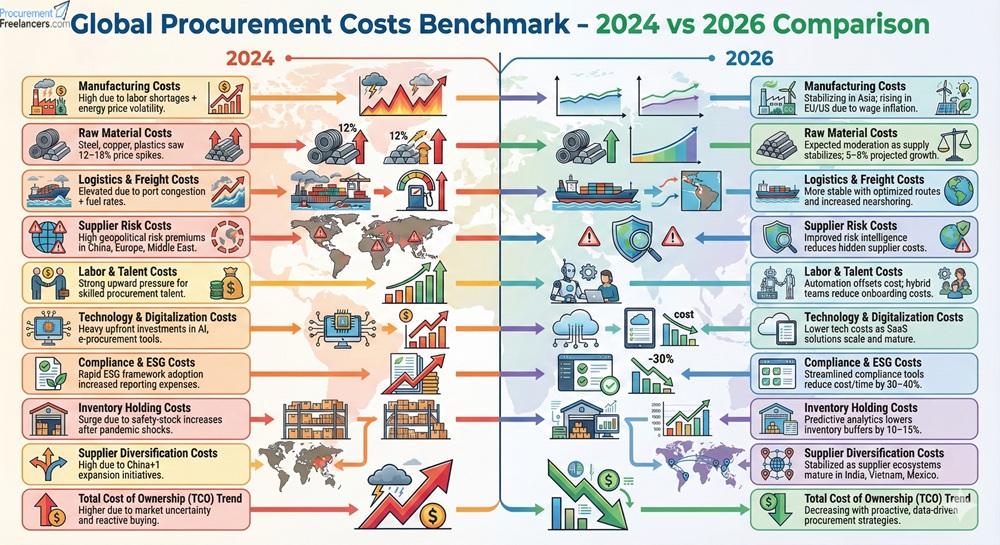
Global Procurement Costs Benchmark—2024 vs. 2026 Comparison
- Manufacturing Costs
- 2024: Higher due to labor shortages and energy price changes.
- 2026: Stabilizing in Asia; rising in the EU/US due to wage inflation.
- Raw Material Costs
- 2024: Steel, copper, and plastics saw 12–18% price issues.
- 2026: Hope for moderation as supply stabilizes; 5–8% projected enhancement.
- Logistics & Freight Costs
- 2024: Enhanced due to port congestion and fuel rates.
- 2026: More stable with optimized routes and enhanced nearshoring.
- Supplier Risk Costs
- 2024: Increased geopolitical risk premiums in China, Europe, and the Middle East.
- 2026: Improved risk intelligence lowers hidden supplier costs.
- Labor & Talent Costs
- 2024: Strong upward pressure for skilled procurement experts.
- 2026: AI-based automation offsets costs; hybrid teams reduce onboarding costs.
- Technology & Digitalization Costs
- 2024: Upfront investments in AI and e-procurement tools.
- 2026: Reduce tech costs as SaaS solutions scale and mature.
- Compliance & ESG Costs
- 2024: More and more ESG framework adoption increased reporting expenses.
- In 2026, the development of streamlined compliance tools is expected to reduce costs and time by 30–40%.
- Inventory Holding Costs
- 2024: Surge due to safety-stock enhancements after pandemic shocks.
- 2026: Predictive analytics reduces inventory buffers by 10–15%.
- Supplier Diversification Costs
- 2024: High due to China+1 expansion initiatives.
- 2026: Stabilized as supplier ecosystems mature in India, Vietnam, and Mexico.
- Total Cost of Ownership (TCO) Trend
- 2024: High due to market uncertainty and reactive buying.
- 2026: Decreasing with proactive, data-driven procurement strategies.
post tags :
artificial intelligence
buying freelancers
buying subcontractors
coronavirus (covid-19)
freelance buyers
GEP solutions company
india procurement freelancer
procurement
procurement agent
procurement agents
procurement agent UK
procurement and sourcing
procurement consultant
procurement consultants
procurement contract management
procurement contract manager freelance
procurement experts
procurement expert UK
procurement professional
procurement subcontractors
procurement technology
Product Sourcing Agent
purchasing agent
purchasing agents
purchasing consultant
purchasing consultants
Purchasing professionals
quality control
quality control experts
quality control subcontractor
quality control subcontractors
quality management system
sourcing agent
sourcing agents
sourcing and procurement consultant
sourcing consultant
sourcing consultants
sourcing subcontractors
Strategic purchasing
supplier auditor
supplier auditors
supplier development
suppliers sourcing solution
supply chain
supply chain management
Your niche talent marketplace