

table of contents
About the Author: Emmanuel Tankpinou

Passionate about optimizing procurement processes and driving innovation in the sourcing world, Emmanuel shares in-depth analyses, practical tips, and key industry trends to help businesses and freelancers excel in their procurement strategies.
With expertise in strategic sourcing, procurement management, and freelance procurement solutions, Emmanuel provides actionable insights that empower organizations to enhance efficiency, reduce costs, and create lasting value.
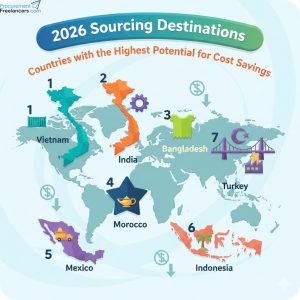
An Infographic – 2026 Sourcing Destinations
Top Countries Delivering Maximum Cost Savings & Competitive Advantage
1. Vietnam
Why it’s rising:
- international standard manufacturing clusters (textile, electronics, furniture)
- Lower labor costs, that is, compete with China
- Expanding free trade agreements
Savings Potential: 20–40% on labor & production
2. India
Why it’s strong:
- Gigantic supplier base across IT, engineering, textiles, and pharmaceuticals
- Government help to provide incentives for export manufacturing
- Competitive skilled-labor workforce across the country
Savings Potential: 25–50% depending on category
3. Bangladesh
Why it stands out:
- One of the world’s lowest-skilled labor but cost-effective markets
- Specialized areas are apparel, home textiles, and leather goods
- Growing compliance standards
Savings Potential: 30–55% in apparel & textile sourcing
4. Morocco
Why it’s emerging:
- Nearshoring advantage for Europe, shipping or transport in 2–3 days
- Competitive costs with high-quality skilled labor and manufacturing
- Strong automotive, textile, and aerospace clusters
Savings Potential: 15–35% + faster lead times
5. Mexico
Why it’s important:
- Nearshoring for the U.S. and Canada with quick delivery times
- Strong market share in automotive, electronics, and industrial components
- Reduced logistics cost vs. Asia
Savings Potential: 10–25% + major time savings
6. Indonesia
Why it’s growing:
- The competitive labor market can compete with other Asian countries
- Large capacity for furniture, footwear, agriculture, and FMCG industries
- Stable export policies
Savings Potential: 20–40% across multiple categories
7. Turkey
Why it matters:
- Strategic location between Europe & Asia; companies may like it
- Fast delivery to EU markets
- Strong textiles, ceramics, and machinery sectors
Savings Potential: 10–30% with shorter lead times
Choosing the right sourcing destination in 2026 = Lower costs + Higher resilience + Faster speed to market.
Businesses that diversify across these countries will gain stronger negotiation power, reduced disruption risks, and more stable supply chains.
Resources for This Infographic
- World Bank – Global Value Chain Development Reports
- UNCTAD – World Investment Reports
- OECD – International Trade & Supply Chain Outlook
- McKinsey Global Institute – Manufacturing & Sourcing Insights
- Deloitte – Global Cost Competitiveness Index
- Kearney – Global Services Location Index (GSLI)
- Asian Development Bank – Cost & Productivity Benchmark Reports
- International Labour Organization (ILO) – Global Wage Database
- World Trade Organization (WTO) – Trade Statistics
- PwC – Country Manufacturing Competitiveness Reports
- Logistics Performance Index (LPI) – World Bank
- Statista – Manufacturing & Export Data by Country
- Country-Specific Investment Agencies (e.g., Invest India, Invest Vietnam, Morocco’s AMDIE, Indonesia Investment Coordinating Board)
post tags :
artificial intelligence
buying freelancers
buying subcontractors
coronavirus (covid-19)
freelance buyers
GEP solutions company
india procurement freelancer
procurement
procurement agent
procurement agents
procurement agent UK
procurement and sourcing
procurement consultant
procurement consultants
procurement contract management
procurement contract manager freelance
procurement experts
procurement expert UK
procurement professional
procurement subcontractors
procurement technology
Product Sourcing Agent
purchasing agent
purchasing agents
purchasing consultant
purchasing consultants
Purchasing professionals
quality control
quality control experts
quality control subcontractor
quality control subcontractors
quality management system
sourcing agent
sourcing agents
sourcing and procurement consultant
sourcing consultant
sourcing consultants
sourcing subcontractors
Strategic purchasing
supplier auditor
supplier auditors
supplier development
suppliers sourcing solution
supply chain
supply chain management
Your niche talent marketplace