
table of contents
About the Author: Emmanuel Tankpinou

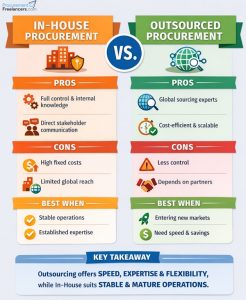
Nowadays companies are facing a critical decision: are they capable in-house, or do they outsource procurement to external experts? Each side has its own advantages, disadvantages, and ideal use cases. We have explained in this infographic the comparison between In-House Procurement vs. Outsourced Procurement, highlighting key pros, cons, and scenarios where outsourcing makes strategic sense. Whether you’re looking to control costs, scale faster, or access global sourcing expertise, this visual guide will help you choose the right procurement model for your business needs.
In-House Procurement
Pros
-
Full internal control
-
Deep knowledge of company processes
-
Direct stakeholder communication
Cons
-
High fixed costs (salary, tools, training)
-
Limited global supplier access
-
Scaling is slow and resource-heavy
Best When
-
Procurement volume is stable
-
Long-term internal expertise already exists
Outsourced Procurement
Pros
-
Access to global sourcing experts
-
Lower operational and hiring costs
-
Faster scaling and flexibility
-
Reduced supplier and compliance risks
Cons
-
Less day-to-day control
-
Requires strong communication alignment
Best When
-
Expanding into new markets
-
Need cost optimization or speed
-
Internal team is overloaded
Key Takeaway
Outsourced procurement offers speed, expertise, and scalability, while in-house procurement suits stable, mature operations.