
table of contents
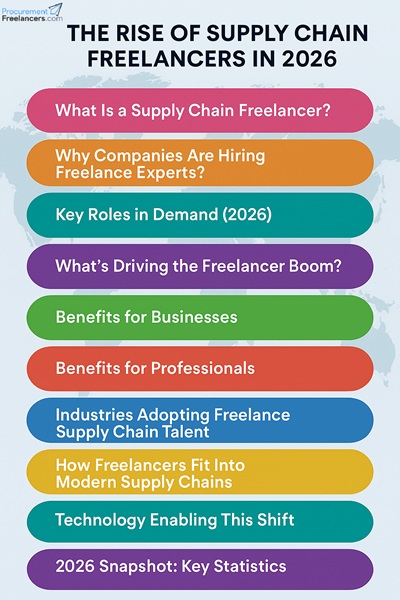
- What Is a Supply Chain Freelancer?
- Why Companies Are Hiring Freelance Experts
- Key Roles in Demand (2026)
- What’s Driving the Freelancer Boom
- Benefits for Businesses
- Benefits for Professionals
- Industries Adopting Freelance Supply Chain Talent
- How Freelancers Fit Into Modern Supply Chains
- Technology Enabling This Shift
- 2026 Snapshot: Key Statistics
- The Future of Supply Chain Work
About the Author: Emmanuel Tankpinou

Introduction
The process of companies building and managing their supply chain teams is rapidly changing. In the current year, 2026, rising cost pressures, talent shortages, global disruptions, and the need for specialized expertise are pressuring companies to rethink traditional, full-time hiring models. In that scenario, supply chain freelancers are emerging as a critical component of modern, agile supply chains along with supply chain consultant for companies.
In many work processes, like procurement and strategic sourcing to logistics optimization and supplier audits, companies are increasingly turning to on-demand supply chain experts, consultants who can work immediately without long-term commitments. These changes are not just about reducing costs; it’s about gaining speed, flexibility, and access to global talent exactly when it’s needed most.
In this infographic, “The Rise of Supply Chain Freelancers in 2026,” we have tried to explain why companies are in need of freelance supply chain professionals, the roles in highest demand, and the benefits for both businesses and experts. And how this trend is transforming the future of supply chain management. It offers a clear snapshot of how organizations can stay competitive by adopting more flexible, skill-based workforce models in an increasingly complex global environment.
The Rise of Supply Chain Freelancers in 2026
What Is a Supply Chain Freelancer?
- Independent supply chain experts
- Work on on-demand, project-based models
- Specialize in procurement, sourcing, logistics, planning, and compliance
- Support companies without long-term hiring
Why Companies Are Hiring Freelance Experts
- High cost of full-time talent
- Urgent need for specialized expertise
- Short-term or crisis-driven requirements
- Faster execution without HR overhead
Key Insight: Speed and flexibility matter more than headcount
Key Roles in Demand (2026)
- Procurement & sourcing consultants
- Supply chain analysts
- Supplier audit & quality experts
- Logistics & freight specialists
- Demand planning & forecasting experts
What’s Driving the Freelancer Boom
- AI & automation reducing routine work
- Global supply chain disruptions
- Rise of remote & cross-border work
- Budget optimization pressure
Trend: Expertise over employment
Benefits for Businesses
- 30–40% lower costs vs full-time hiring
- Faster project turnaround
- Access to global talent
- Scalable workforce on demand
Benefits for Professionals
- Flexible work models
- Higher earning potential
- Global client exposure
- Skill-based opportunities
Industries Adopting Freelance Supply Chain Talent
- Manufacturing
- Retail & eCommerce
- FMCG
- Healthcare
- Energy & Industrial sectors
How Freelancers Fit Into Modern Supply Chains
- Plug-and-play expertise
- Project-based sourcing & audits
- Crisis management support
- Digital transformation initiatives
Technology Enabling This Shift
- Digital sourcing platforms
- Collaboration & project tools
- AI-driven analytics
- Secure cloud-based systems
2026 Snapshot: Key Statistics
- 45% companies use freelance supply chain experts
- 40% procurement projects outsourced short-term
- 50% professionals prefer independent consulting
- 25% faster project completion rates
The Future of Supply Chain Work
- Hybrid teams (in-house + freelancers)
- On-demand procurement models
- Skill-based hiring replacing role-based hiring
- Greater reliance on expert networks
Resources & References
- Gartner – Future of Supply Chain & Workforce Models
(Agile supply chains, flexible talent adoption, on-demand expertise) - McKinsey & Company – Supply Chain Talent & Operating Model Reports
(Cost optimization, resilience, external expert usage) - Deloitte – Global Procurement & Supply Chain Survey
(Freelance talent, digital procurement, workforce transformation) - PwC – Workforce of the Future & Supply Chain Insights
(Hybrid teams, skill-based hiring, project-based work models) - World Economic Forum (WEF) – Global Supply Chain Resilience Reports
(Future-ready supply chains, talent flexibility, digital ecosystems) - Harvard Business Review (HBR) – Articles on Agile & Networked Organizations
(Project-based work, expert networks, organizational agility) - Statista – Global Freelance Economy & Supply Chain Data
(Freelancer growth, industry adoption trends) - BCG (Boston Consulting Group) – Supply Chain Transformation Studies
(Operational agility, cost efficiency, external expertise) - IBM – Digital Supply Chain & Workforce Automation Reports
(AI-driven collaboration, intelligent supply chain models) - Upwork & LinkedIn Workforce Reports
(Rise of freelance professionals, enterprise adoption patterns)