

table of contents
- Step 1: Oil Prices Surge
- Step 2: Transportation Costs Increase
- Step 3: Production Costs Go Up
- Step 4: Supplier Prices Rise
- Step 5: Final Product Prices Increase
- Step 6: Procurement Pressure Intensifies
- Key Insight
- What Procurement Leaders Should Do
- Oil Shock to Procurement: Cost Chain Reaction Table
- Strategies to Mitigate Impact
About the Author: Emmanuel Tankpinou

Introduction:
The geopolitical situation is worse in the Middle East now. Oil price fluctuations are no longer just an energy sector concern; rather, they directly impact procurement strategies worldwide. The Iran–US–Israel tensions disrupt supply routes, like the Strait of Hormuz, and trigger sudden spikes in crude oil prices, setting off a chain reaction across the entire supply chain.
Procurement experts are facing many issues, including rising transportation costs, increased supplier pricing, and shrinking margins. In the businesses, procurement teams face mounting pressure to maintain cost efficiency and operational stability. It starts from the oil shock and quickly evolves into a multi-layered cost escalation affecting production, logistics, and final product pricing.
We are trying to explore it in this infographic by step-by-step cost chain reaction, helping procurement professionals understand the hidden impact of oil price volatility and take proactive measures to mitigate risk and control costs.
How rising oil prices during geopolitical conflicts silently increase your procurement costs
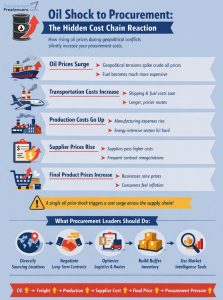
Step 1: Oil Prices Surge
-
Geopolitical tensions disrupt supply routes and production
-
Crude oil prices spike rapidly in global markets
-
Fuel becomes significantly more expensive
Step 2: Transportation Costs Increase
-
Shipping (sea, air, road) becomes costlier
-
Freight rates and fuel surcharges rise sharply
-
Longer routes add extra logistics expenses
Step 3: Production Costs Go Up
-
Higher fuel costs increase manufacturing expenses
-
Energy-intensive industries are hit the hardest
-
Raw material processing becomes more expensive
Step 4: Supplier Prices Rise
-
Suppliers pass increased costs to buyers
-
Contract renegotiations become frequent
-
Reduced profit margins across the supply chain
Step 5: Final Product Prices Increase
-
Businesses raise prices to maintain margins
-
Inflation impacts end consumers
-
Demand fluctuations begin
Step 6: Procurement Pressure Intensifies
-
Budget constraints tighten
-
Cost-saving targets become harder to achieve
-
Procurement teams face increased risk and complexity
Key Insight
A single oil price shock can trigger a multi-layer cost increase across the entire procurement ecosystem.
What Procurement Leaders Should Do
-
Diversify sourcing locations
-
Negotiate long-term contracts
-
Optimize logistics and routes
-
Build buffer inventory
-
Use real-time market intelligence tools
Oil Shock to Procurement: Cost Chain Reaction Table
| Stage | What Happens | Impact on Procurement | Business Risk Level |
|---|---|---|---|
| 1. Oil Price Surge | Crude oil prices increase due to geopolitical tensions and supply disruptions | Higher fuel costs across all operations | 🔴 High |
| 2. Transportation Costs Rise | Freight, shipping, and logistics costs increase significantly | Increased landed cost of goods | 🔴 High |
| 3. Production Costs Increase | Manufacturing becomes more expensive due to higher energy costs | Reduced margins and increased sourcing costs | 🔴 High |
| 4. Supplier Prices Go Up | Suppliers pass on increased costs to buyers | Frequent price revisions and contract renegotiations | 🟠 Medium–High |
| 5. Final Product Prices Increase | Businesses raise prices to maintain profitability | Demand fluctuation and customer resistance | 🟠 Medium |
| 6. Procurement Pressure Intensifies | Teams face budget constraints and cost-saving challenges | Difficulty in achieving procurement KPIs | 🔴 High |
Strategies to Mitigate Impact
| Challenge | Recommended Procurement Action |
|---|---|
| Rising logistics cost | Optimize routes and consolidate shipments |
| Supplier price increase | Negotiate long-term contracts |
| Supply disruption | Diversify sourcing locations |
| Cost visibility issues | Use real-time procurement analytics tools |
| Demand uncertainty | Build buffer inventory |